Can a treasure hunt fix a broken loyalty loop?
Taco Bell's Rewards program had 8M active users but a retention problem. I designed a B2B2C gaming platform to give users a reason to come back.
Duration: Jan–July 2025 · Team: CEO · CTO · Product Designer
29M users downloaded Taco Bell's app, but only 16% came back for more.
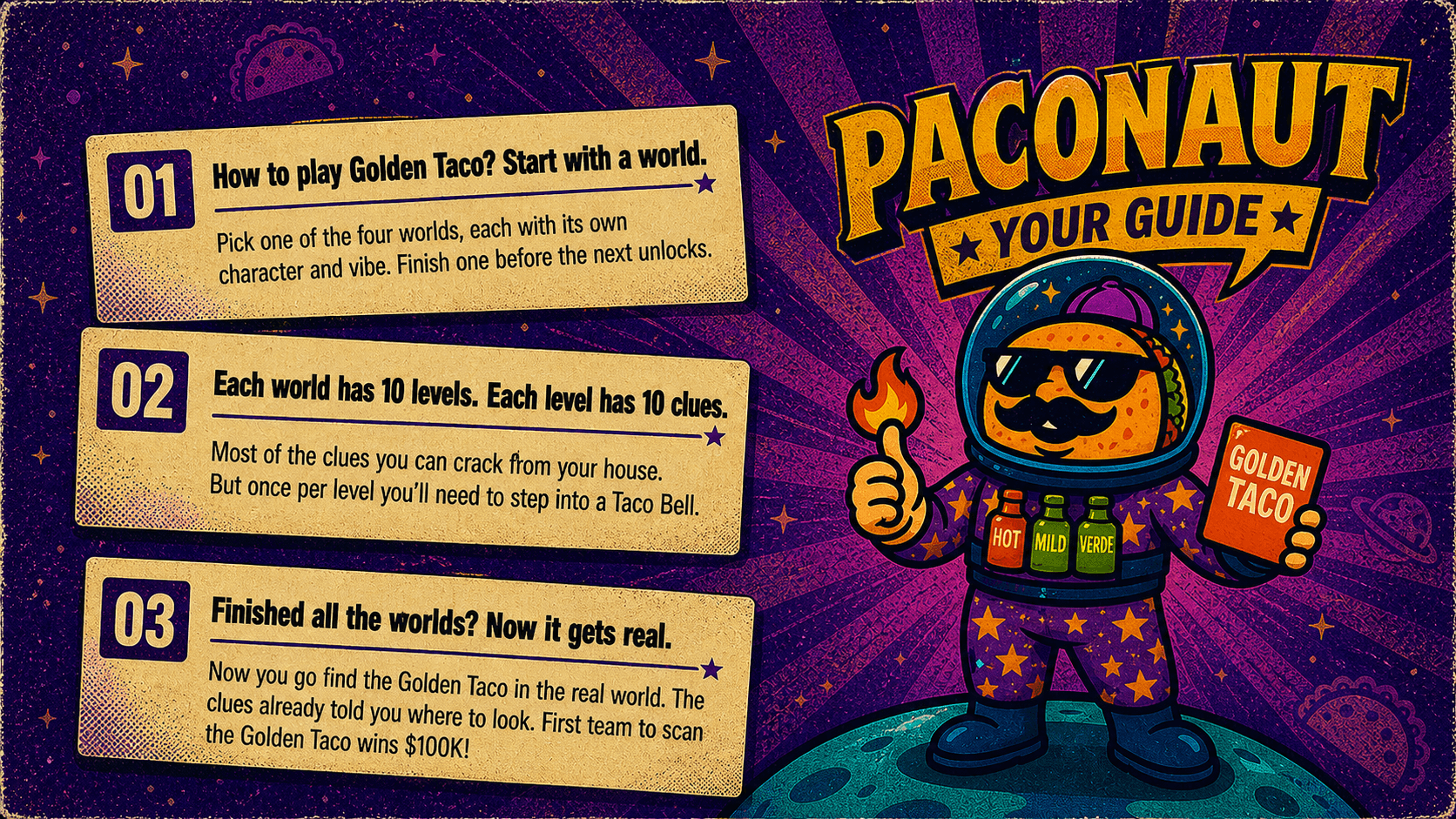
The app was supposed to drive store visits and expand Taco Bell's audience, but users left after their first free taco. At Treasure Game$, a phygital gaming company, we saw an opportunity: what if the reward was a real prize worth chasing with friends and family, one that sent you out into the world to find it?
84%
of subscribers churn after their first free taco.
1.9 ★
on Google Play, one of the lowest in the QSR category.
"just another coupon app."
recurring sentiment across 190K reviews.
Every QSR that gamified their app pulled millions in weeks.
McDonald's Monopoly drove 77M digital interactions, a 25% spike in app downloads, and a +10% sales lift in six weeks. Chipotle's Burrito Vault pulled 3.5M plays in 2025. Burger King's Whopper Detour drove 1.5M app downloads in nine days. That's how the Golden Taco Treasure Hunt came to life!
Listening to the closest proxy to our future Taco Bell audience.
I interviewed 9 first-time players of Wish Lamp$, Treasure Game's flagship treasure hunt, to find out if what we assumed about engagement and team dynamics actually held up.
Every player is a potential team.
The first session was the only chance to turn one player into a group. If the onboarding convinced them, they invited the rest. If it didn't, they kept playing solo and the team never formed.
Playing together was the whole point.
We thought basic team support was enough. Interviews showed bonding across distance, age, and busy schedules was the real reason people played. That pushed us to build deeper team features from day one.
Turning passive time into active play.
Players replaced solo screen time with Wish Lamp$, but retention came from the physical-digital mix. It turned a passive habit into active play and gave people a reason to do it together.
The MVP had one job: prove the hunt drove real visits and real loyalty sign-ups.
Three things had to work from day one: clue progression, team dynamics, and a reward logic tied to store visits and Rewards sign-ups. With no historical data, we built in levers to tune difficulty and respond when in-store visit rates dropped. The goal wasn't to get it perfect. It was to get it running well enough to know what perfect looked like.